UNIT -3
Design of organization structure
The following are the various types of organization structure:
1. Line Organization
2. Functional Organization


3. Line and Staff Organization
4. Committee Organization
5. Project Organization
6. Matrix Organization
1. Line Organization:Line organization is the basic framework for the whole organization. It represents a direct vertical relationship through which authority flows. This is the simplest and oldest, known as chain of command or scalar principle. The authority flows from top to the lower levels.
Types of Line Organization:
Line organization is of two types:
(a) Pure Line Organization.
(b) Departmental Line Organization.
(a) Pure Line Organization-In pure line organization all persons at a given level perform the same type of work. The divisions are solely for the purpose of control and direction

(b) Departmental Line Organization-The whole organization is put under the overall control of Chief
Executive who may be called by the name of General Manager. Different
departments are put under the control of Departmental Managers.
Departmental managers get orders directly from the General Manager. The
managers are not dependent upon each other. Every department has its own
line of organization. There may be deputy managers, supervisors,
workers in every department. The deputy managers get orders from the
departmental manager and in turn pass them on to the supervisors.
2. Functional Organization:It is based on the functional foremanship. Under this method, the structure of the enterprise is classified into different functional areas. Each functional area is headed by a specialist who has full control of that function over the organization and gives instructions direct to the personnel, rather than through the chain of command
3. Line and Staff Organization:Line and staff organization is a combination of functional and line structure. Line authority flows from top to bottom and the line executive is directly concerned with the accomplishment of primary objectives.
To provide specialized assistance to line mangers, staff positions are created. Staff means a stick in the hand for support. Thus, staff helps the line executives in their work. They play the role of an advisor.
4. Committee Organization:A committee is a group of persons who consciously and deliberately formed to discuss a problem and provide solutions to overcome it. They meet on an organized basis to discuss and deal with the matter placed before it.
5. Project Organization:The use of the project organization has increased in the last few years. It is currently being employed in numerous undertakings engaged in the execution of construction activities, turnkey projects and research and development projects. The project organization can take various forms, but the important characteristic that distinguishes it from other forms is once the project is completed the organization is disbanded or phased out.
6 Matrix Organization:It is a combination of project organization and functional organization.In the matrix structure, employees may report to two or more bosses depending on the situation or project. For example, under normal functional circumstances, an engineer at a large engineering firm could work for one boss, but a new project may arise where that engineer’s expertise is needed. For the duration of that project, the employee would also report to that project’s manager, as well as his or her boss for all other daily tasks.

NEXT TOPIC-Job Design and Job Enrichment
Definition: The Job Design means outlining the task, duties, responsibilities, qualifications, methods and relationships required to perform the given set of a job.
The objective of a job design is to arrange the work in such a manner so as to reduce the boredom and dissatisfaction among the employees, arising due to the repetitive nature of the task.
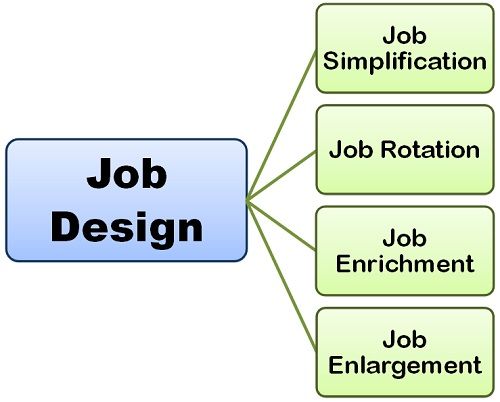
There are several important methods and techniques that the management uses while designing the jobs. These are:
a) Job Enrichment-The Job Enrichment is the job design technique used to increase the satisfaction among the employees by delegating higher authority and responsibility to them and thereby enabling them to use their abilities to the fullest.The purpose behind the job enrichment is to motivate the employees to use their abilities which remained unused during their course of action. Also, through job enrichment, the monotony breaks and the employees get the opportunity to do something new, which ultimately results in the increased satisfaction levels.
c) The Job Simplification means breaking the job into relatively easier sub-parts with the intention to enhance the individual’s productivity by minimizing the physical and mental efforts required to perform a complex job.Once the complex task is divided into the relatively easier tasks, each task is assigned to the individuals who perform these over and over again. By doing the same thing again and again, the employees gain proficiencies in the jobs assigned to them and as a result, the profitability of the organization increases.
d) Job Rotation is the management technique wherein an employee is shifted from one job role to the other, with the purpose of familiarizing him with all the verticals of an organization.the management trainees who are a fresher in the business world are shifted to different job positions to make them understand the functions of business more precisely. The purpose of a job rotation is to reduce the monotony of work and letting an employee to acquire multi skills required for performing different tasks in the organization.
NEXT TOPIC- job evaluation and merit rating.
Job evaluation -Job evaluation is a process of determining the relative worth of a job. It is a process which is helpful even for framing compensation plans by the personnel manager. Job evaluation as a process is advantageous to a company in many ways:
- Specialization - Because of division of labour and thereby specialization, a large number of enterprises have got hundred jobs and many employees to perform them. Therefore, an attempt should be made to define a job and thereby fix salaries for it. This is possible only through job evaluation.
- Helps in selection of employees - The job evaluation information can be helpful at the time of selection of candidates. The factors that are determined for job evaluation can be taken into account while selecting the employees.
- Harmonious relationship between employees and manager - Through job evaluation, harmonious and congenial relations can be maintained between employees and management, so that all kinds of salaries controversies can be minimized.
- Standardization - The process of determining the salary differentials for different jobs become standardized through job evaluation. This helps in bringing uniformity into salary structure.
- Relevance of new jobs - Through job evaluation, one can understand the relative value of new jobs in a concern.
Merit rating-Merit rating is concerned with measuring and evaluating employee performance after he is placed on a job.
Objectives of Merit Rating-
1. To serve as a basis for pay adjustments when the job rate is not fixed.
2. To serve as a basic for special rewards such as a share in profit and periodic bonuses.
3. To determine qualifications for the assignment of work.
4. To determine the promotional qualifications.
5. To remove the unfits and misfits.
6. To determine who should be retained when work is slack.
7. To select candidates for special training.
8. To assist in the development of employees by finding out their talents and weaknesses.
Procedure for Designing a Merit Rating Programme:
1. Determine the employee groups to be covered and the purpose of performance rating
2. Set up a training method by selecting and defining performance traits to be appraised and preparing a rating scale.
3. Select and train raters.
4. Check and interpret performance scores and use the information for granting individual wage advances, employee counseling, training and the like.
Comments
Post a Comment